Diagnostic Efficacy of SOFA Score in Predicting Outcome and Mortality: An ICU Experience from Pakistan
Muhammad Ali Abbas Malik1Shamaila Mumtaz2 Faran Maqbool2Javaria Malik4Saima Mir5Muhammad Imran Saeed6
1Rawalpindi Medical University, Rawalpindi, Pakistan
Objective: To determine the cut off value of Sequential Organ Failure Assessment score at the time of admission in Intensive Care Unit to predict mortality and outcome in critically ill patients.
Methodology:This cross-sectional, descriptive study was undertaken at Intensive Care Unit of Rawalpindi Teaching Hospital, Rawalpindi, Pakistan between April and August 2023. SOFA score of all critically ill patients at the time of admission in ICU and their outcome (expired or discharged) was recorded. Receiver Operator Characteristics Curve (ROC) was drawn for SOFA score and mortality. Cut off value for SOFA score was calculated. Outcome of patients above and below the cut off value for SOFA score was studied using Chi-square test.
Results:A total of 100 patients (54% females and 46% males) were included in the study with mean patient age of 68.93±11.09 years. Out of 100 patients, 48 (48%) improved and 52 (52%) expired. The mean initial SOFA score was 5.44±3.99 in patients who improved and 9.91±4.20 in patients who expired. Coordinates of the ROC curve showed that SOFA score cut off value 7.5 had best corresponding sensitivity (0.777) and specificity (0.740). The patients were categorized to group I (SOFA score≤7), and group II (SOFA score ≥8).34.04% of the group I and 75.47% of the g5roup II patients expired (p-value 0.0000001)
Conclusion:Mortality was higher in patients who had higher SOFA score at the time of admission in Intensive Care Unit. At admission SOFA scores (≤7 and >8) are best predictor of outcome in critically ill patients.
Key words:Sequential Organ Failure Assessment score, Outcome, Mortality
In third world countries like Pakistan there is acute shortage of beds and experienced staff in Intensive Care Units. Therefore, the scoring systems that can predict outcome and mortality at the time of initial presentation are of great use. One of these scoring systems is Sequential Organ Failure Assessment (SOFA) score.1 It can help intensivists to distinguish patients with better expected outcome from those with poor expected outcome and thus improves their decision making in terms of allocation of resources and management plan.
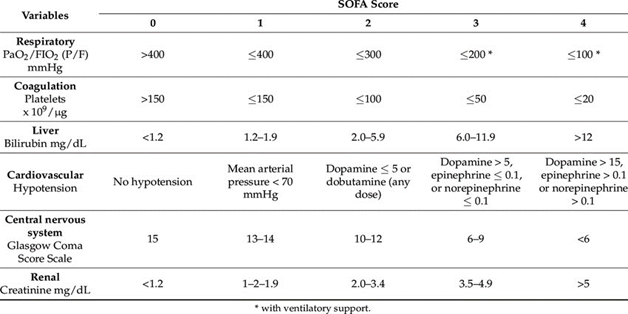
There are many scoring systems that are routinely used in Intensive Care Units worldwide. These include Sequential Organ Failure Assessment (SOFA) score,1 Simplified Acute Physiology score2 (SAPS), Mortality Probability Model3 (MPM) and Acute Physiology and Chronic Health Evaluation4 (APACHE). Many studies have been conducted in past to study the diagnostic accuracy of these scoring systems in predicting outcome and mortality in critically ill patients.5 Available data suggests that SOFA scoring system performs better in predicting outcome as well as need for ventilatory support in critically ill patients6. The parameters used to calculate SOFA score include respiration, circulation, renal, haematological, hepatic and central nervous system related.1 Maximum SOFA score is 24 and minimum is 0. (Annexure I)
Data related to utility of SOFA Score in Intensive Care Units of Pakistan is limited. Therefore, this study was conducted to find out a cut off value of SOFA score at the time of ICU admission that can predict favourable and poor outcome and mortality in Pakistani population.
After approval from Hospital Ethics Review Board this single-centre, prospective, cross-sectional, descriptive study was conducted at Intensive Care Unit of Rawalpindi Teaching Hospital, Rawalpindi, between April and August 2023. All patients admitted in ICU during the study duration regardless of their diagnosis were included in the study by using convenient sampling technique.
Written informed consent was taken from all patients (or relatives) prior to data collection All patients were assessed by taking standard medical history and conducting a physical examination by single intensivist. Standard management protocol was used for management of each illness. A specifically designed proforma was used to record information for all patients. Demographic parameters (including age, gender, area of residence, level of education), diagnosis, base-line SOFA score, need for mechanical ventilation, duration of hospital stay (in days) and outcome (expired/discharged) were recorded.
Descriptive statistics and logistic regression analysis were performed for statistical assessment. All descriptive statistics were presented as means and standard deviations (SD) for quantitative variables (age, SOFA score, duration of hospital stay) and as relative frequencies and percentages for categorical variables (gender, diagnosis, outcome). All recorded data was entered into Statistical Package for the Social Sciences (SPSS) version 18 for analysis. Receiver Operator Characteristics Curve (ROC) was drawn for SOFA score and outcome and best cut off value of SOFA scores was calculated. Chi-square test was used to study outcome of patients above and below this cut off value.
A total of 100 patients were included in the study, 54 (54%) were female and 46 (46%) were male. Out of these 100, 37 (37%) patients were uneducated, 8 (8%) had been to elementary school, 12 (12%) to middle school, 30 (30%) to high school, while only 13 (13%) were graduates. Mean duration of patient stay in ICU was 6.71 ± 3.11 days. Out of 100 patients, 52 patients (52%) expired while remaining 48 patients (48%) improved. The patients who improved were either discharged from ICU or shifted to medical ward.
Most common primary diagnosis in order of frequency included cerebro-vascular accident (27%), sepsis (23%), acute on chronic renal failure (21%), poisoning (9%) and diabetic ketoacidosis (8%). Highest mortality was recorded in patients with cerebrovascular accident (15 out of 27 patients).
The mean initial SOFA score was 5.44±3.99 in patients who improved and 9.91±4.20 in patients who expired (p-value 0.000). Mean age of patients with favourable outcome (improved) was 42.25±15.07 and with poor outcome (expired) was 63.48±13.88 (p-value 0.065). Poor outcome (death) was documented among 55% males and 60% females (p-value 0.28).
ROC area under the curve was 0.815. Coordinates of the ROC curve showed that SOFA
score cut off value 7.5 had best corresponding sensitivity (0.777) and specificity (0.740). The patients were categorized to Group I (SOFA score ≤7), and Group II (SOFA score ≥8). 34.04% of the Group I and 75.47% of the Group II patients expired (p-value 0.0000001). There were significant differences among two groups in terms of mean age, baseline SOFA score and outcome. However, there was not much difference in duration of ICU stay in both groups. The results are shown in Table 1.
|
|
SOFA≤7 (n=47) |
SOFA score ≥8 (n=53) |
p-value |
|
MEAN SOFA SCORE (BASELINE) |
5.44±3.99 |
9.91±4.20 |
0.000 |
|
MEAN AGE (YEARS) |
42.25±15.07 |
63.48±13.88 |
0.065 |
|
MEAN DURATION OF ICU STAY |
6.66 ± 3.1O |
6.75 ± 3.25 |
0.410 |
|
POOR OUTCOME (MORTALITY) |
16 OUT OF 47 PATIENTS (34.04%) |
40 OUT OF 53 PATIENTS (75.47%) |
LESS THAN 0.001 |
The Sequential Organ Failure Assessment (SOFA) score was developed more than 25 years ago to provide a simple method of assessing and monitoring organ dysfunction in critically ill patients. It rapidly became one of the most widely used scoring systems in adult intensive care, both in clinical practice and research7,8. The SOFA score can provide quick information about how well the organs are functioning or how quickly they are failing9.
Available worldwide data suggests that higher initial SOFA score is predictor of mortality10. In a study conducted to predict mortality in ICU patients admitted with Systemic Inflammatory response, the mortality was 90% in those with baseline SOFA score >1111 .However, the SOFA score has not been well studied in Pakistani Intensive Care Units. Therefore, this study was conducted to find out a cut off value of SOFA score at the time of ICU admission that can predict favourable and poor outcome and mortality in Pakistani population.
In our study, the common primary diagnosis in order of frequency included cerebro-vascular accident (27%), sepsis (23%), acute on chronic renal failure (21%), poisoning (9%) and diabetic ketoacidosis (8%). Highest mortality was recorded in patients with cerebrovascular accident (15 out of 27 patients). However, in developing countries like Pakistan the outcome of patients admitted in ICU not only depends upon the primary diagnosis and severity of illness but also on delayed presentation of patients and lack of available resources including ICU trained staff. 12
Available data suggests that patients with advanced age and female gender have relatively poor outcome irrespective of primary diagnosis13-15. In our study, mean age of patients with favourable outcome (improved) was 42.25±15.07 and with poor outcome (expired) was 63.48±13.88. Poor outcome (death) was documented among 55% males and 60% females in our study. Similar results have been observed in previous studies Health Evaluation16-17
In our study, the Mean initial SOFA score was 5.44±3.99 in patients who improved and 9.91±4.20 in patients who expired. This difference in baseline SOFA score between two groups is statistically significant. Therefore the patients who have higher SOFA score ≥8 at presentation in Emergency department should be given preference for ICU admission and managed more aggressively. Multiple studies that were conducted in Intensive Care Units in different parts of the world during COVID-19 pandemic showed similar results18-19
Our study suggests that at admission SOFA scores (≤7 and >8) are best predictor of outcome in critically ill patients. However, there are certain limitations of our study including not focusing on primary diagnosis, co-morbidities and serial SOFA score which should be taken into account in future research.
Mortality was higher in patients who had higher SOFA score at the time of admission in Intensive Care Unit. At admission SOFA scores (≤7 and >8) are best predictor of outcome in critically ill patients.
- Ferreira FL, Bota DP, Bross A, Mélot C, Vincent JL. Serial evaluation of the SOFA score to predict outcome in critically ill patients. JAMA. 2001;286:1754–8 https://doi.org/10.1001/jama.286.14.1754 Le Gall JR, Lemeshow S, Saulnier F. A new simplified acute physiology score (SAPS II) based on a European/North American multicenter study. JAMA. 1993;270:2957–63 https://doi.org/10.1001/jama.270.24.2957
- Higgins TL, Kramer AA, Nathanson BH, Copes W, Stark M, Teres D. Prospective validation of the intensive care unit admission Mortality Probability Model (MPM0-III) Crit Care Med. 2009;37:1619–23 https://doi.org/10.1097/ccm.0b013e31819ded31
- Minne L, Abu-Hanna A, de Jonge E. Evaluation of SOFA-based models for predicting mortality in the ICU: A systematic review. Crit Care. 2008;12:R161 https://doi.org/10.1186/cc7160
- Moreno R, Vincent JL, Matos R, Mendonça A, Cantraine F, Thijs L, et al. The use of maximum SOFA score to quantify organ dysfunction/failure in intensive care. Results of a prospective, multicentre study. Working Group on Sepsis related Problems of the ESICM. Intensive Care Med. 1999;25:686–96 https://doi.org/10.1007/s001340050931
- Marshall JC, Cook DJ, Christou NV, Bernard GR, Sprung CL, Sibbald WJ. Multiple organ dysfunction score: A reliable descriptor of a complex clinical outcome. Crit Care Med. 1995;23:1638–52 https://doi.org/10.1097/00003246-199510000-00007
- Hanormand A, Safavi M, Mordi D. The use of infection probability score and sequential organ failure assessment scoring system inpredicting mechanical ventilation requirement and duration. Turkish Journal of Trauma and Emergency Surgery,2009; 15(5): 440-7
- Esteban A, Anzueto A, Frutos F, Alia I, Brochard L, Stewart TE, et al. Characteristics and outcome in adult patients receiving mechanical ventilation a 28-day international study. JAMA 2002;287:345-55 https://doi.org/10.1001/jama.287.3.345
- Extrapulmonary manifestations of COVID-19. Gupta A, Madhavan MV, Sehgal K, et al. Nat Med. 2020 https://doi.org/10.1038/s41591-020-0968-3 Evaluating Apache and sofa scoring systems in patients with COVID-19. Gowda N, Dominah G, Rogers H, Elshikh a, Gowda S, Benjenk Ivy, Yamane D. Chest. 2021;160:0 https://doi.org/10.1016%2Fj.chest.2021.07.997

An Official Publication of
Islamabad Medical & Dental College
Volume 12 Issue 4
Editorial
Address of Correspondence
Shamaila Mumtaz
Email:
shumaila.daud81@yahoo.com
Cite this article.Malik AAM, Mumtaz S, Maqbool F, Malik J, Mir S, Saeed IM. Diagnostic Efficacy of SOFA Score in Predicting Outcome and Mortality: An ICU Experience from Pakistan. J Islamabad Med Dental Coll. 2022; 12(4): 305-309. DOI: https://doi.org/10.35787/jimdc.v12i4.1064