Distribution and Antibiotic Sensitivity of Burn Wound Colonization in Referred Patients at the Burn Care Centre, PIMS, Islamabad, Pakistan
Ali Mujtaba1, Muhammad Rehan1, Ifra Eeman Ahmed2, Tariq Iqbal1, Shabab Hussain3, Rabia Mahmood2, Nimrah Komal4
1Burn Care Centre, PIMS, SZABMU, Islamabad, Pakistan; 2Federal Medical College, Islamabad; 3Burns and Plastic Surgery Unit Lady Reading Hospital, Peshawar 4Health services Academy Islamabad
Objectives: The objective of this study was to determine the prevalence of common bacterial infections among referred patients, with a minimum delay of one week, and to assess their bacteriological susceptibility at the Burn Care Centre, PIMS, Islamabad.
Methodology: This retrospective descriptive study was conducted between March 2021 and February 2023. We reviewed wound swab culture results spanning 24 months, primarily from referred patients. Wound specimens were collected using sterile swabs and standard techniques from registered patients, then analyzed at the microbiological laboratory based on patients' culture reports.
Results: A total of 226 culture reports were assessed, comprising 95 (42.04%) male patients and 131 (57.96%) female patients, with a mean age of 21 years (range: 11 months to 65 years). Among these reports, 16 (7.08%) showed no growth. Pseudomonas aeruginosa was identified in 88 patients (38.93%), while Staphylococcus aureus (MRSA) was present in 57 (25.22%), Klebsiella pneumoniae in 36 (15.93%), and a combination of Klebsiella and Pseudomonas in 18 (7.96%) cases, as per the swab culture reports. Escherichia coli was detected in 3 (1.33%) cases and Enterobacter in 2 (0.88%) cases. Other bacteria were found in 6 (2.65%) swab culture reports. Pseudomonas and Klebsiella exhibited maximum susceptibility to Polymyxin B, at 67.04% and 61.11%, respectively, while MRSA showed the highest susceptibility to linezolid, at 89.47%.
Conclusion: Pseudomonas aeruginosa, Staphylococcus aureus, and Klebsiella pneumoniae were the most prevalent bacteria among patients referred to our Burn Care Center. Referred burn patients were found to be colonized with multi-drug resistant bacteria, compared to inpatient cases at our center.
Keywords: Antibiotic sensitivity, Burn, Multi-drug resistant, Klebsiella pneumonia, Pseudomonas aeruginosa, Staphylococcus aureus
Burn injuries have emerged as a significant global public health concern, posing substantial risks of both mortality and morbidity.1 The incidence of severe burn injuries worldwide in 2004 was estimated to be approximately 11 million which was
higher than the incidence of tuberculosis and HIV combined making it the fourth leading cause of main injuries.2 Unique to burn patients is their heightened susceptibility to a spectrum of infections, attributable to compromised skin integrity and generalized immune suppression3. The resultant alteration of the skin barrier creates an environment rich in proteins but devoid of vascularity, fostering microbial colonization and proliferation. Concurrently, impaired immune cell migration sets the stage for a septic cascade, compounded by the escalating prevalence of drug-resistant pathogens4. Both Gram-negative and Gram-positive bacteria constitute the primary constituents of burn wound colonization. Furthermore, the dynamic nature of bacterial isolates and their evolving susceptibility to antibiotics underscore the necessity for continual updates in treatment protocols.
Multi-drug-resistant (MDR) organisms represent a significant challenge in the management of burn patients, posing substantial obstacles to successful treatment outcomes.5 Burn injuries, characterized by compromised skin barriers and impaired immune responses, create an ideal environment for the proliferation of MDR bacteria.6 Methicillin-resistant Staphylococcus aureus (MRSA), Vancomycin-resistant Enterococcus spp. (VRE), and other MDR pathogens are increasingly implicated in burn wound infections, exacerbating morbidity and mortality rates.7,8 The complex interplay between MDR organisms and burn injuries necessitates a comprehensive understanding of their epidemiology, mechanisms of resistance, and clinical implications.9
Therefore, this study aimed to identify the microorganisms and their susceptibility patterns isolated from burn wounds at the Burn Care Center (BCC) of Pakistan Institute of Medical Sciences (PIMS) in Islamabad, Pakistan. This investigation is instrumental in informing the development of empirical therapy strategies customized to the needs of acute burn patients.
This retrospective descriptive study, conducted at the Burn Care Centre (BCC), Pakistan Institute of Medical Sciences (PIMS), Islamabad, Pakistan, from March 2021 to February 2023, aimed to examine wound swab culture results of referred patients with burn injuries. A total of 226 cultures were reviewed, primarily focusing on patients presenting at least one-week post-burn trauma. Patients came from the Islamabad Capital Territory (ICT) as well as were referred from other hospitals in the provinces of Gilgit Baltistan (GB) and Azad Kashmir (AK), Pakistan. Wound specimens were collected during routine dressing changes from patients displaying signs of infection, with samples repeated for those with hospital stays exceeding one week. Swab stick cultures were obtained from infected burn wounds, and empirical antibiotics were initiated for patients exhibiting systemic infection symptoms. Samples were collected prior to wound wash and subsequently sent for culture and susceptibility testing.
Bacterial identification and antimicrobial susceptibility were assessed using standard microbiological techniques. Cultures were plated onto MacConkey agar and 5% sheep blood agar and then incubated at 37°C for 24 hours. Following incubation, gram staining was performed to visualize microbial growth. The Disc Diffusion Method was utilized to determine antibiotic susceptibilities on plates demonstrating microbial growth. Identification of isolates was initially carried out using conventional biochemical methods, with confirmation performed using the Phoenix Automated Microbiology System (Becton, Dickinson-USA). MDR of Pseudomonas aeruginosa and Acinetobacter spp were identified if they exhibited resistance to at least three antimicrobial groups, including antipseudomonal cephalosporins, antipseudomonal fluoroquinolones, antipseudomonal carbapenems, beta-lactam beta-lactamase inhibitor combinations, or
In our study, a total of 226 culture reports were assessed. These swab cultures were taken from referred patients with a delay of at least 1 week to BCC PIMS, Islamabad. Out of the total cultures, 95 (42.04%) were male patients while 131 (57.96%) were females. The mean age of population in the study was 21 years (range 11 months to 65 years). The child population comprised 87 (38.50%) individuals. Flame burns accounted for 91 (40.26%) cases, followed by scald burns at 79 (34.96%), electric burns at 37 (16.37%), and chemical burns at 3 (1.33%). Cultures with no growth were observed in 16 (7.08%) cases. Gram-negative bacterial growth was predominant, with 153 (67.70%) of the total swab culture reports. Pseudomonas was present in 88 out of the 210 patients (38.93%), followed by Staphylococcus aureus (MRSA) at 57 (25.22%). Swab cultures with Klebsiella pneumoniae were observed in 36 cases (15.93%), while Klebsiella and Pseudomonas combined accounted for 18 (7.96%) of the swab culture reports. Escherichia coli was detected in 3 cases (1.33%), and Enterobacter in 2 cases (0.88%). Other organisms were identified in 6 cases (2.65%). Multi-drug resistant (MDR) pseudomonas was found in 12 (13.63%) out of 88 cultures. Cultures with no growth were 16(7.08%). The percentage prevalence and number of organisms in culture swabs are indicated in Table II.
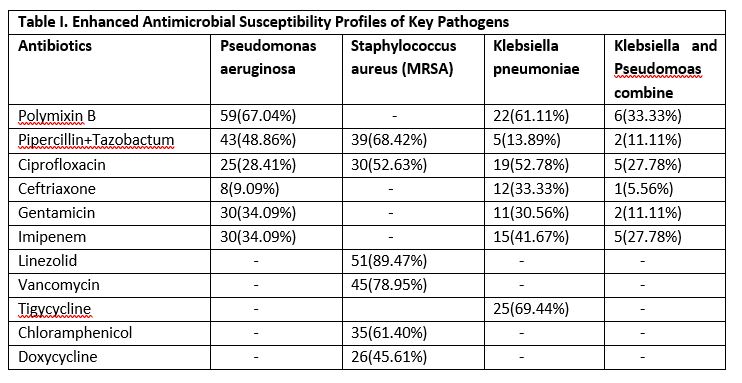
Pseudomonas exhibited maximum susceptibility to Polymixin B, with 59 out of 88 cases (67.04%) showing susceptibility. Pipercillin+Tazobactum demonstrated susceptibility in 43 cases (48.86%), followed by Ciprofloxacin in 25 cases (28.41%), Ceftriaxone in 8 cases (9.09%), Imipenem and Gentamicin in 30 cases each (34.09%). MRSA displayed the highest susceptibility to linezolid, with 51 cases (89.47%) followed by Vancomycin in 45 cases (78.95%), Pipercillin+Tazobactum in 39 cases (68.42%), Chloramphenicol in 35 cases (61.40%), Ciprofloxacin in 30 cases (52.63%), and Doxycycline in 26 cases (45.61%). Klebsiella pneumoniae demonstrated maximum susceptibility to Polymixin B in 22 cases (61.11%). Pipercillin+Tazobactum was susceptible in 5 cases (13.89%), Ciprofloxacin in 19 cases (52.78%), Ceftriaxone in 12 cases (33.33%), Imipenem in 15 cases (41.67%), Tigecycline in 25 cases (69.44%), and Gentamicin in 11 cases (30.56%). Klebsiella and Pseudomonas combined exhibited the highest susceptibility to Polymixin B in 6 cases (33.33%), followed by Imipenem and Ciprofloxacin, each with 27.78% susceptibility. Further details of minor susceptibilities are provided in Table I.
Table II. Analysis of culture report characteristics from referred patients at BCC PIMS |
||
Microorganism |
Number of cultures(n) |
Percentage prevalence |
Pseudomonas aeruginosa |
88/226 |
38.93% |
Methcillin-resistant Staphylococcus aureus |
57/226 |
25.22% |
Klebsiella pneumoniae |
36/226 |
15.93% |
Klebsiella and Pseudomoas combine |
18/226 |
7.96% |
Escherichia coli |
3/226 |
1.33% |
Enterobacter |
2/226 |
0.88% |
Others |
6/226 |
2.65% |
This study aimed to depict the type and occurrence of bacterial pathogens and their sensitivity to various antibiotics isolated from burn wound colonization of referred patients with at least a 1-week delay in presentation to the burn care centre, PIMS. In this study, we retrospectively analyzed the swab cultures collected from 226 patients referred from other hospitals to BCC, PIMS. Out of 210 positive burn wound cultures gram-negative bacteria were present in 153(67.70%), while gram-positive bacteria were present in only 57(25.22%) burn wounds. This is consistent with the study done by Gong et al which showed the prevalence of gram-negative and gram-positive bacteria to be 68.44% (232/339) and 24.48% (83/339) respectively.10 Although culture sensitivity of burn wounds has been studied previously at BCC, PIMS little is known about the bacteriological profile of referred burn patients with at least a 1-week delay in presentation.11 In addition, at BCC PIMS no specific guidelines are established for empiric antibiotic administration in referred burn patients. Antibiotic drugs were prescribed by doctors based on experience before identifying the microorganism and its susceptibility profile to colonizing burn wounds, which is in accordance to strategies followed worldwide.12
In our study, gram-negative isolates were predominantly more compared to gram-positive ones, the most frequent bug isolated was a gram-negative bacillus (Pseudomonas aurogenosa). This is consistent with many studies that report pseudomonas as the main bacteria colonizing burn wounds.11,13,14 Some studies reported pseudomonas as the second most common bug in burn wounds.15,16 Pseudomonas was most susceptible to polymixin B followed by pipercillin+tazobactum, gentamicin, imipenem, and ciprofloxacin in order. When comparing to previous study by Saaiq et al11 conducted at our BCC PIMS the sensitivity of pseudomonas decreased from 80.6% to 48.86% for pipercillin+tazobactum and from 63.88% to 34.09% for imipenem. This shows the increasing resistance of pseudomonas to antibiotics and its ability to acquire genes encoding resistance determinants. The mounting prevalence of multiply drug-resistant P. aeruginosa has shifted the treatment of choice for P. aeruginosa infection from carbapenems to polymyxins. Carbapenem is attributed as the last line antibiotic for multi-drug resistant (MDR) infections. In addition, polymixins have substantial side effects limiting their prolonged use.17 This makes the management of MDR burn infections challenging due to limited options that are more toxic with limited efficacy. The colonization of MDR microbs in referred is more which shows that burn care centers implement infection prevention through a number of different strategies such as hand hygiene protocols, strict environmental cleaning ,Prompt removal of catheters colonized with biofilm-producing pathogens in the setting of infection ,Contact isolation of patients known to have multidrug-resistant organisms and many more.
Staphylococcus (MRSA) is the second most common bug isolated from burn wounds. Another study done at BCC PIMS showed the prevalence of S.aureus to be 11.6% which is lower than percentage of S.aureus in our study that is 25.22%.18 This depicts the increased percentage of resistant microbes among referred patients. Studies done in Tunisia, China, and Turkey have shown S.aureus as the commonest organism isolated from burn wounds.15,19,20 In contrast, other studies in Pakistan, Iraq, and Palestine show S.auresus as the second, third, or fourth common organism.13,14 Due to topical use of antibiotics over recent years, S.aureus, the most frequent bug cultured from burn wounds, has become uncommon. Alarmingly all S. aureus strains were methicillin-resistant, no methicillin-sensitive strains were identified. MRSA is found not only in hospitals (healthcare-associated MRSA, HA-MRSA) but also outside healthcare facilities (community-associated MRSA, CA-MRSA). The presence of only MRSA in our study indicates either HA-MRSA/CA-MRSA or the use of topical antibiotics before admission to the hospital. MRSA was sensitive to linezolid, vancomycin, Chloramphenicol, and Doxycycline.
In our study, the third most common organism isolated was Klebsiella species. Various studies done in Asia and Africa have reported this organism as the first or second commonest organism in the antibiogram of burn wounds. Klebsiella species were sensitive to polymyxin B and tigecycline.21 This again indicates the resistant strains isolated in our study suggesting difficult management of burn infections in referred patients.
Klebsiella and pseudomonas combined were the fourth most common bugs separated from bacterial colonization. They were sensitive to levofloxacin, imipenem, and polymixin B. Other microbes isolated from burn wounds were E. coli, Enterobacter, and others.
Thus, there is a striking difference in the bacteriological profile and sensitivity analysis of burn wounds in referred patients compared to the antibiogram of in-hospital patients at our centre which was previously established by Saaiq et al.11 This could help us establish our empiric cover for our burn patients who are referred from other institutes to BCC, PIMS
In our study, resistant microbial colonization of burn wounds among referred patients indicate that burn care centers play pivotal role in infection prevention and thus help in improving the outcomes of patients with burn injuries. Regular antibiograms should be encouraged to track changes in antimicrobial resistance and establishment of optimum empiric antibiotic cover. Lastly a referral system should be established for better management and outcomes of burn patients.
- Kiley JL, Greenhalgh DG. Infections in burn patients. Surgical Clinics. 2023 Jun 1;103(3):427-37. https://doi.org/10.1016/j.suc.2023.02.005
- da Fonseca AD, de Paoli F, Mencalha AL. Photodynamic therapy for treatment of infected burns. Photo diagnosis and Photodynamic Therapy. 2022 Jun 1; 38:102831. https://doi.org/10.1016/j.pdpdt.2022.102831
- Church D, Elsayed S, Reid O, Winston B, Lindsay R. Burn wound infections. Clinical microbiology reviews. 2006 Apr;19(2):403-34. https://doi.org/10.1128/cmr.19.2.403-434.2006
- Raz-Pasteur A, Hussein K, Finkelstein R, Ullmann Y, Egozi D. Blood stream infections (BSI) in severe burn patients—early and late BSI: a 9-year study. Burns. 2013 Jun 1;39(4):636-42. https://doi.org/10.1016/j.burns.2012.09.015
- Catalano A, Iacopetta D, Ceramella J, Scumaci D, Giuzio F, Saturnino C, Aquaro S, Rosano C, Sinicropi MS. Multidrug resistance (MDR): A widespread phenomenon in pharmacological therapies. Molecules. 2022 Jan 18;27(3):616. https://doi.org/10.3390/molecules27030616
- Ruegsegger L, Xiao J, Naziripour A, Kanumuambidi T, Brown D, Williams F, Marshall SH, Rudin SD, Yen K, Chu T, Chen L. Multidrug-resistant gram-negative bacteria in burn patients. Antimicrobial agents and chemotherapy. 2022 Sep 20;66(9): e00688-22. https://doi.org/10.1128/aac.00688-22
- Hoque MN, Jahan MI, Hossain MA, Sultana M. Genomic diversity and molecular epidemiology of a multidrug-resistant Pseudomonas aeruginosa DMC30b isolated from a hospitalized burn patient in Bangladesh. Journal of Global Antimicrobial Resistance. 2022 Dec 1; 31:110-8. https://doi.org/10.1016/j.jgar.2022.08.023
- Kalligeros M, Shehadeh F, Karageorgos SA, Zacharioudakis IM, Mylonakis E. MRSA colonization and acquisition in the burn unit: A systematic review and meta-analysis. Burns. 2019 Nov 1;45(7):1528-36. https://doi.org/10.1016/j.burns.2019.05.014
- Cabral L, Rodrigues L, Tavares AH, Tomé G, Caetano M, Chaves C, Afreixo V. Analysis of Potential Risk Factors for Multidrug-Resistance at a Burn Unit. European Burn Journal. 2023 Jan 11;4(1):9-17. https://doi.org/10.3390/ebj4010002
- Gong YL, Yang ZC, Yin SP, Liu MX, Zhang C, Luo XQ, Peng YZ. Analysis of the pathogenic characteristics of 162 severely burned patients with bloodstream infection. Zhonghua Shao Shang za zhi= Zhonghua Shaoshang Zazhi= Chinese Journal of Burns. 2016 Sep 1;32(9):529-35. https://doi.org/10.3760/cma.j.issn.1009-2587.2016.09.004
- Saaiq M, Ahmad S, Zaib MS. Burn wound infections and antibiotic susceptibility patterns at Pakistan Institute of Medical Sciences, Islamabad, Pakistan. World journal of plastic surgery. 2015 Jan;4(1):9. https://pmc.ncbi.nlm.nih.gov/articles/PMC4298859/
- Avni T, Levcovich A, Ad-El DD, Leibovici L, Paul M. Prophylactic antibiotics for burns patients: systematic review and meta-analysis. Bmj. 2010 Feb 15;340. https://doi.org/10.1136/bmj.c241
- Rehan M, Iqbal T, Ghaffar N, Komal N, Khan MS. Bacteriological profiling of burn wound infections at the national burn care centre of Pakistan. BMC Journal of Medical Sciences. 2023 Feb 5;4(1):43-8.
- Al Laham NA, Elmanama AA, Tayh GA. Possible risk factors associated with burn wound colonization in burn units of Gaza strip hospitals, Palestine. Annals of burns and fire disasters. 2013 Jun 6;26(2):68. https://pubmed.ncbi.nlm.nih.gov/24133399/
- THABET L, TURKI A, BEN REDJEB S, ALLAH MESSADI A. Profil bactériologique et résistance aux antibiotiques des bactéries isolées dans un service de réanimation des brûlés durant deux ans. Tunisie médicale. 2008;86(12):1051-4
- Leseva M, Arguirova M, Nashev D, Zamfirova E, Hadzhyiski O. Nosocomial infections in burn patients: etiology, antimicrobial resistance, means to control. Annals of burns and fire disasters. 2013 Mar 3;26(1):5. https://pubmed.ncbi.nlm.nih.gov/23966892/
- Kunin CM, Bugg A. Recovery of tissue bound polymyxin B and colistimethate. Proceedings of the Society for Experimental Biology and Medicine. 1971 Jul;137(3):786-90. https://doi.org/10.3181/00379727-137-35667
- Ali U, Rehan M, Khan MS, Iqbal T. Prevalence of different bacteria and their antibiotic susceptibilities in BCC Pims. JSM Burns Trauma. 2017;2(3):1021. https://doi.org/10.47739/2475-9406/1021
- Shao F, Ren WJ, Meng WZ, Wang GZ, Wang TY. Burn wound bacteriological profiles, patient outcomes, and tangential excision timing: a prospective, observational study. Ostomy Wound Manage. 2018 Sep 1;64(9):28-36
- Erol S, Altoparlak U, Akcay MN, Celebi F, Parlak M. Changes of microbial flora and wound colonization in burned patients. Burns. 2004 Jun 1;30(4):357-61. https://doi.org/10.1016/j.burns.2003.12.013
- Srinivasan S, Saldanha J, Abhyankar S, Patil A, Vartak AM. Bacteriology of the burn wound at the Bai Jerbai Wadia hospital for children, Mumbai, India-A 21-year study of predominant Pseudomonas species. International Journal of Burns and Trauma. 2018;8(4):98. https://pmc.ncbi.nlm.nih.gov/articles/PMC6146167/

An Official Publication of
Islamabad Medical & Dental College
Vol 13 No (Suppl.)
Address of Correspondence
Ifra Eeman Ahmed
Email:
abbasiifra55@gmail.com
Authors’ Contribution: 1,2Conception; Literature research; manuscript design and drafting; 3,4 Critical analysis and manuscript review; 5,6,7Data analysis; Manuscript Editing.
Cite this article. Mujtaba A, Rehan M, Ahmed IE, Iqbal T, Hussain S, Mahmood R, Komal N. Distribution and Antibiotic Sensitivity of Burn Wound Colonization in Referred Patients at the Burn Care Centre, PIMS, Islamabad, Pakistan J Islamabad Med Dental Coll. 2024; 13i(Suppl.): 536-5441. DOI: https://doi.org/10.35787/jimdc.
v13i(Suppl.).1228