Frequency of Isolation of Coagulase Negative Staphylococcus from Blood Cultures and its Antibiogram
Nadia Aslam1, Nazma Kiran2, Naima Mehdi 3
1 Professor, Department of Pathology, Rai Medical College, Sargodha
2 Associate Professor, Department of Pathology, Rai Medical college, Sargodha.
33Assistant Professor, Department of Pediatric microbiology, The Children’s Hospital and University of Child Health Sciences, Lahore
Background:
Coagulase-negative Staphylococci are members of stable skin inhabitants. They are frequent contaminants in blood cultures and can lead to unnecessary exposure of patients to antimicrobial drugs and excess hospital costs. This study aims to estimate the frequency of Coagulase-negative Staphylococci in blood cultures and their antibiograms.
Methods: This cross-sectional study was performed in a tertiary care hospital over one year from April 2018 to March 2019. Blood cultures received in the laboratory were processed to isolate Coagulase-negative Staphylococci. Susceptibility to various antimicrobial drugs was detected by disc diffusion method and E-strips.
Results:A total of 13802 blood cultures were processed in one year. 1750 blood cultures yielded bacterial growth and 374 blood cultures were positive for Staphylococci. Out of these 374 blood cultures, 97 were categorized as Staphylococcus aureus and 277 were Coagulase-negative Staphylococci. Out of 13802 total blood cultures performed during study period, 277 blood cultures positive with Coagulase negative Staphylococcus means contamination rate of 2% out of total blood cultures. 277 Coagulase negative Staphylococcus positive cultures out of 1750 positive blood cultures means contamination rate of 15.8% out of positive blood cultures. Among Coagulase-negative Staphylococci, 68.2% isolates were resistant to Cefoxitin, 95.3% to Penicillin, 85.1% to Erythromycin, 37.5% to Ciprofloxacin, 59.6% to Gentamicin, 68.6% to Fusidic acid, 3.6% to Teichoplanin, and 1.4% to Linezolid. All isolates were sensitive to Vancomycin.
Conclusion: : The rate of blood culture contamination was 2% out of total blood cultures and 15.8% out of positive blood cultures.
Key words: Antibiogram, Bacteremia, Blood culture, Drug resistance
Coagulase-negative Staphylococci (CoNS) are members of the normal flora of the skin1, 2. There are more than 40 species of CoNS. They are members of the genus Staphylococcus but they are unable to produce coagulase and they are less virulent and pathogenic than Staphylococcus aureus2. These organisms rarely cause disease in a healthy population. CoNS being multidrug-resistant may get selected due to excessive use of antimicrobials in hospitals and their ability to form biofilms can lead to foreign body-related or device-associated healthcare infections2. Blood cultures are of crucial importance in diagnosing septicemia in critically ill patients3. Blood culture contamination/pseudo bacteremia may occur when cultures get contaminated with microbial flora of skin due to ineffective or inappropriate sterile technique being practiced while drawing blood specimen or processing of cultures. Blood cultures give false-positive results with organisms that were not present in the bloodstream4. Blood culture contamination is quite a common issue encountered in microbiology laboratories. CoNS are frequent isolates from microbiological culture and are considered as culture contaminants3-5. CoNS being opportunistic pathogens can cause nosocomial infections and are multi-drug resistant2. Therefore, it is of utmost importance to differentiate between blood culture contamination and true bacteremia to avoid prolonged hospital stays, excessive costs and unneeded exposure of patients to antimicrobial drugs in a hospital setting which can ultimately select for drug-resistant organisms such as vancomycin-resistant Enterococci.5 Several guidelines are available to differentiate blood culture contaminants from pathogens but the true “gold standard” is yet not determined3, 5. If only one blood culture out of a set of two is positive it is presumed to be blood culture contamination and if both bottles yield organism that is considered as true bacteremia5. CoNS considered as true contaminants of blood culture in past are more recently reported as a cause of true bacteremia in some patients5.
Blood culture contamination with CoNS being a member of skin flora may result from the faulty technique. False-positive blood cultures may lead to a prolonged hospital stay and unnecessary treatment with anti-staphylococcal drugs leading to additional costs. This study was conducted to estimate the frequency and percentage of CoNS isolation from blood cultures and their antimicrobial drug resistance pattern.
This cross-sectional study was carried out at the microbiology laboratory of a tertiary care hospital, from April 2018 to March 2019.
All blood culture samples received in the microbiology laboratory during the period of study were processed to isolate CoNS. One positive blood culture out of a set of two was presumed to be blood culture contamination. Repeat samples from the same patients were excluded.
The total blood cultures (13802) received in the pathology laboratory over the period of one year were processed to isolate members of Genus Staphylococcus. Blood culture bottles were processed after 48 hours of incubation, subculture was done on solid media (chocolate and MacConkey’s agar).
Identification was done based on colonial morphology and gram stain. After overnight incubation at 35°C, each distinctive colony morph type was selected and gram stain was performed. Gram positive cocci arranged in clusters were selected and catalase test was performed. Gram-positive, catalase-positive cocci were labeled as Staphylococci. Tube coagulase and deoxyribonuclease (DNase) tests were performed to differentiate among Staphylococcus aureus and Coagulase negative Staphylococci. The organisms with coagulase and DNase-test negative were labelled coagulase-negative Staphylococci. The frequency of CoNS in blood cultures was calculated and recorded. Antimicrobial drug susceptibility test was performed. Organisms were suspended in Mueller-Hinton broth to the turbidity of a 0.5 McFarland standard and then plated on Mueller-Hinton agar. Susceptibility of CoNS to various drugs like Penicillin (10 U), Cefoxitin (30 μg), Gentamicin (10 μg), Ciprofloxacin (5 μg), Erythromycin (15 μg), Fusidic acid (10 μg), Linezolid (10 μg), Vancomycin (30 μg) and Teichoplanin (30 μg) was detected by using disc diffusion technique and E strips according to Clinical and Laboratory Standards Institute (CLSI) recommendations.6 Susceptibility of isolates to various drugs was detected and was reported as frequency and percentages.
A total of 13802 blood cultures were processed in one year. 1750 (12.7%) blood cultures yielded bacterial growth. The most frequent isolated from blood cultures were gram-negative bacteria followed by Staphylococci and Enterococci. Out of 1750 blood cultures, 1130 (64.5%) blood cultures yielded gram negative bacteria, 374 (21.4%) blood cultures were positive for Staphylococci. Out of these 374 blood cultures, 97(25.9%) were categorized as S. aureus and 277 (74.1%) were CoNS.
Frequency of CoNS was 2% (277/13802) out of total blood cultures while frequency of CoNS was 15.8% (277/1750) out of positive blood cultures.
Antimicrobial drug susceptibility was performed and drug resistance pattern in CoNS has been shown in Graph 1.
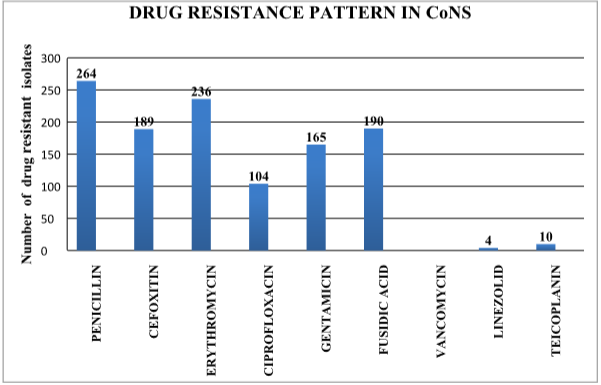
Graph 1: Frequency of drug resistance in coagulase-negative Staphylococci (n=277)
Blood culture contamination with commensal skin flora leads to increased costs, prolonged hospital stays, and patient morbidity. Unnecessary and prolonged hospitalization and antimicrobial drug use can lead to healthcare-associated infections.7 This study was conducted to determine the rate of blood culture contamination.
In this study, the frequency of CoNS was 2% out of total blood cultures and 15.8% out of positive blood cultures. A study conducted by Khan F et al reported CoNS were isolated in 10.6% of positive blood cultures.8 A study by Malik S et al reported 18% contamination rate of the blood culture9. While according to Gupta S et al, rate of blood culture contamination by CoNS was 17.4% of positive cultures10. The rate of blood culture contamination should be calculated and monitored to devise appropriate measures and interventions to keep the rate low as 2–3%7, 9, 11. Studies have documented that implementing aseptic techniques and better skin antisepsis significantly reduces the blood culture contamination rate12.
A study by Geisler BP et al demonstrated that dedicated and trained phlebotomists can play a positive role in decreasing the rate of blood culture contamination and this can lead to decreased health care costs and unnecessary use of antimicrobial drugs13. Even by implementing simple informational intervention aiming at increasing basic knowledge and skill of phlebotomists can be effective in decreasing blood culture contamination significantly14.
Drug susceptibility pattern revealed 95.3% of CoNS were resistant to Penicillin, 68.2% to Cefoxitin, 85.1% to Erythromycin, 59.6% to Gentamicin, and 68.6% to Fusidic acid. The majority of CoNS are drug-resistant especially to Cefoxitin and Methicillin.2 Contamination of blood cultures with an organism that is not present in the bloodstream can lead to unnecessary prolongation of hospital stay, excesscosts and exposure to undesired effects of broad-spectrum antibiotics15. Studies have reported that approximately more than 59% of the patients with blood culture contamination with CoNS received antimicrobial therapy especially Vancomycin16. In this study Teichoplanin resistance was found in 3.6% and Linezolid resistance in 1.4% of CoNS. Teicoplanin resistance in CoNS is reported by several studies17. Another study by Gu B reported Linezolid resistance in 1.4% of CoNS18. Inappropriate use of antimicrobials especially Vancomycin, Teicoplanin and Linezolid for false-positive blood cultures can lead to the selection of resistant strains and this can pose a threat to the spread and survival of resistant strains in hospitals thus leading to nosocomial infections. CoNS may serve as a reservoir of drug resistance genes and it can transfer those genes to other more virulent true pathogens especially S. aureus2. The strength of the study is that it depicts the rate of blood culture contamination in a particular hospital and setting, this study highlights the urgent need for devising strategies to reduce the rate of blood culture contamination. The limitations of this study are that in the absence of a true gold standard for determining blood culture contamination some cases of true bacteremia may be reported as blood culture contaminants.
The rate of blood culture contamination was 2% out of total blood cultures and 15.8% out of positive blood cultures.
CoNS can contaminate blood cultures and are usually multidrug-resistant. Therefore, interventions should be devised and implemented directed towards better skin antisepsis, improving the knowledge and skill of phlebotomists to reduce the rate of blood culture contamination. The rate of blood culture contamination should be monitored in health care facilities in pre- and post-intervention periods to monitor the effect of those interventions.
- Argemi X, Hansmann Y, Prola K, Prévost G. Coagulase-Negative Staphylococci Pathogenomics. Int J Mol Sci. 2019; 20(5): 1215. Doi: 10.3390/ijms20051215
- Becker K, Heilmann C, Peters G. Coagulase-Negative Staphylococci. Clin Microbiol Rev. 2014; 27(1-2): 870–926. Doi: 10.1128%2FCMR.00109-13
- Sidhu SK, Malhotra S, Devi P, Tuli AK. Significance of coagulase-negative Staphylococcus from blood cultures: persisting problems and partial progress in resource-constrained settings. Iran J Microbiol. 2016; 8(6) :366–71. PMC 5420390
- Laupland KB, Church DL. Population-Based Epidemiology and Microbiology of Community Onset Bloodstream Infections. Clin Microbiol Rev. 2014; 27(4): 647–64. Doi:10.1128/CMR.00002-14
- Elzi L, Babouee B, Vögeli N, Laffer R, Dangel M, Frei R, et al. How to discriminate contamination from bloodstream infection due to coagulase-negative staphylococci: a prospective study with 654 patients. Clin Microbiol Infect. 2012; 18(9): E355–61. Doi: 10.1111/j.14690691.2012. 03964.x
- Clinical and Laboratory Standards Institute. Performance standards for antimicrobial susceptibility testing. 28th ed. CLSI supplement M100 2018.
- Alnami AY, Aljasser AA, Almousa RM, Torchyan AA, Bin Saeed AA, Al-Hazmi AM, et al. Rate of blood culture contamination in a teaching hospital: a single center study. J Taibah Univ Med Sci 2015; 10(4): 432-6. Doi: 10.1016/j.jtumed.2015.08.002
- Khan F, Kirmani S, Siddiqui N, Sultan A, Sami H, Mahtab Md, et al. CoNS in blood culture: contaminants or pathogens? Int J Curr Microbiol App Sci 2015; 1: 88-94.
- Malik S, Ravishekhar K. Significance of coagulase negative staphylococcus species in blood culture. J Clin Diagn Res 2012; 6(4): 632-35.
- Gupta S, Kashyap B. Bacteriological profile and antibiogram of blood culture isolates from a tertiary care hospital of North India. Trop J Med Res 2016; 1992): 94-9. Doi: 10.4103/1119-0388.185426
- Bentley J, Thakore S, Muir L, Baird A, Lee J. A change of culture: reducing blood culture contamination rates in an Emergency Department. BMJ Qual Improv Rep. 2016; 5(1): u206760.w2754. Doi:10.1136/bmjquality.u206760.w2754
- Marlowe L, Mistry RD, Coffin S, Leckerman KH, McGowan KL, Dai D, et al. Blood culture contamination rates after skin antisepsis with chlorhexidine gluconate versus povidone-iodine in a pediatric emergency department. Infect Control Hosp Epidemiol. 2010; 31(2): 171-6. Doi: 10.1086/650201
- Geisler BP, Jilg N, Patton RG, Pietzsch JB. Model to evaluate the impact of hospital-based interventions targeting false-positive blood cultures on economic and clinical outcomes. J Hosp Infect. 2019; 102(4): 438-44. Doi: 10.1016/j.jhin.2019.03.012
- Roth A, Wiklund AE, Palsson AS, Melander EZ, Wullt M, Cronqvist J, et al. Reducing blood culture contamination by a simple informational intervention. J Clin Microbiol. 2010; 48(12): 4552–8. Doi: 10.1128/jcm.00877-10
- Hughes JA, Cabilan CJ, Williams J, Ray M, Coyer F. The effectiveness of interventions to reduce peripheral blood culture contamination in acute care: a systematic review protocol. Syst Rev. 2018; 7(1): 216.Doi: 10.1186/s13643-018-0877-4
- Dempsey C, Skoglund E, Muldrew KL, Garey KW. Economic health care costs of blood culture contamination: A systematic review. Am J Infect Control.2019;47(8):9637.
Doi:10.1016/j.ajic.2018.12.020. - Cremniter J, Slassi A, Quincampoix JC, Sivadon-Tardy V, Bauer T, Porcher R, et al. Decreased Susceptibility to Teicoplanin and Vancomycin in Coagulase-Negative Staphylococci Isolated from Orthopedic-Device-Associated Infections. J Clin Microbiol. 2010; 48(4): 1428–31. Doi: 10.1128/JCM.02608-12
- Gu B, Kelesidis T, Tsiodras S, Hindler J, Humphries RM. The emerging problem of linezolid-resistant Staphylococcus. J Antimicrob Chemother. 2013; 68(1): 4-11. Doi: 10.1093/jac/dks354

An Official Publication of
Islamabad Medical & Dental College
Volume 10 Issue 3
Author's Contribution:
1Conception; Literature research; manuscript design and drafting; 2, Critical analysis and manuscript review; 3 Data analysis; Manuscript Editing.
Article info:
Received: December 4, 2019
Accepted: September 2, 2021
Funding Source: Nil
Conflict of Interest: Nil
Address of Correspondence
Nadia Aslam
Email:
drnadia76@yahoo.com
Cite this article. Aslam N, Kiran N, Mehdi N. Frequency of Isolation of Coagulase Negative Staphylococcus from Blood Cultures and Its Antibiogram. J Islamabad Med Dental Coll. 2021; 10(3): 140-144. Doi: 10.35787/jimdc.v10i3.468